
About East Lake Advancing Dentistry
East Lake Advancing Dentistry is a family dental practice at 20397 Yorba Linda Blvd in Yorba Linda, California, located in the Von's East Lake Village Center. Its stated philosophy treats drilling as destruction: once tooth structure is removed it is gone permanently, so the clinical mindset is to minimize removal and preserve the natural dentition. The practice describes an oral-systemic rationale for this work, citing research linking heart disease, diabetes, autoimmune disorders, dementia and Alzheimer's to the bacterial and viral load in the mouth, and it aims to resolve infection in the mouth and gums before that infection produces cavities or periodontitis. Restorative work follows adhesive principles — ultraconservative inlays and onlays in place of full crowns where possible, nonmetallic materials, and ceramic fibers used to reinforce weakened teeth along engineering lines. Pre-drilling diagnostics include ozone, air abrasion and caries scanning.
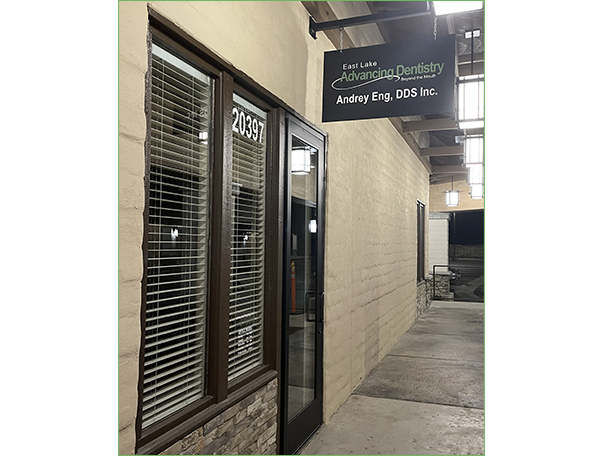
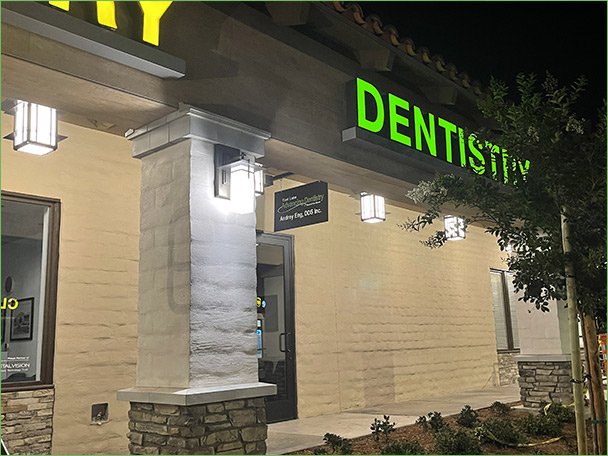
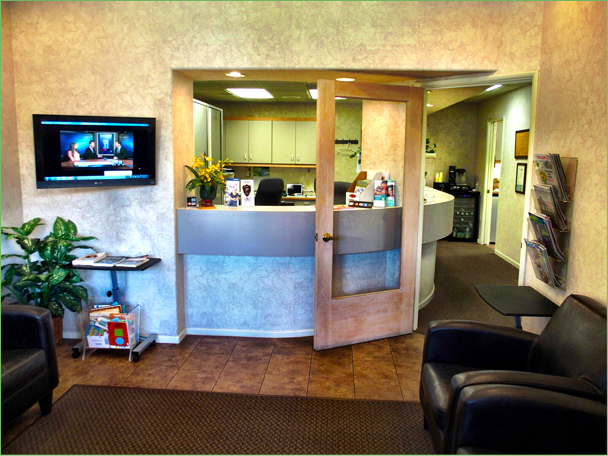
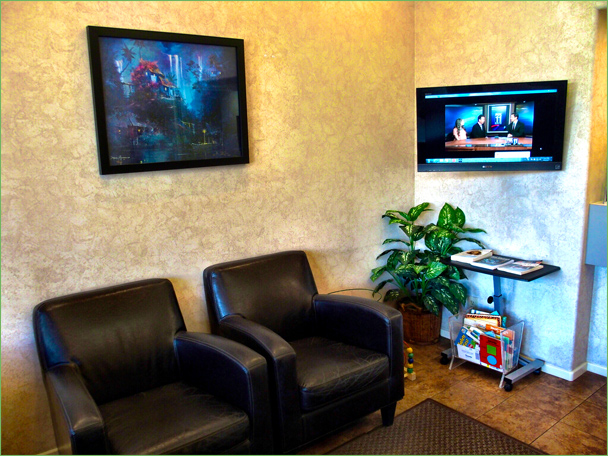
Photos from the practice’s website. Something wrong, or is this your practice? Email hello@biomimeticclinics.com.
Credentialed Clinician
Dr. Andrey Eng
Directory memberAOBMD recordverified 30 August 2026
Procedures
Practice Details
- Address: 20397 Yorba Linda Blvd, Yorba Linda, CA 92886, United States
- Telephone: (714) 779-2736
- Website: https://www.andreyengdds.com/
- City: Yorba Linda, CA (all California practices)
Common Questions
What does this practice mean when it says it works biomimetically?
The practice defines biomimetic dentistry as ultraconservative adhesive tooth restoration — creating a lifelike copy of natural tooth structure rather than replacing it. It traces the lineage to Buonocore's 1955 adhesive dentistry and Ray Bertolotti's 1985 reintroduction as adhesion dentistry, and states its core aim as preserving and restoring as much natural tooth structure as possible using current adhesive materials.
Why would an inlay or onlay be recommended here instead of a crown?
The practice states that where possible it restores a tooth with an ultraconservative inlay or onlay rather than a full crown, because a full crown generally requires drilling away 50 to 80 percent more tooth. It describes sealing the tooth against infection and bonding it to resist fracture as the way to interrupt the cycle in which dental work leads to further dental problems. Existing full restorations still require full restorations when replaced.
What does the practice do before resorting to the drill?
It describes a set of pre-drilling options: ozone, air abrasion and caries scanning to diagnose and treat infection before numbing and drilling are needed. The technology gives a readout of whether decay is present and how much, and provides indicators during treatment so no more tooth is removed than necessary. As the practice notes, a black spot on a tooth does not by itself mean a cavity.
How does this practice handle weakened or badly broken-down teeth?
It reports using Ribbond ceramic mesh fibers in larger restorations and ceramic fibers to reinforce weak teeth, describing the approach as borrowed from modern engineering concepts. Stated aims of its adhesive protocol include minimizing shrinkage stress on the tooth, preserving pulp vitality to avoid unnecessary root canals, and restoring teeth that traditional approaches would extract. Metal pins, which the practice associates with microfractures, are not used.
Does the practice treat jaw joint pain and TMD?
Yes. It distinguishes TMD, a group of conditions involving pain and dysfunction of the temporomandibular joint or the surrounding musculature, from the joint itself. Its stated position is that conservative, reversible measures should be exhausted before anything irreversible such as bridgework or surgery, and that examination at the dental office is the first step in identifying the problem area. A custom nightguard is described for nocturnal clenching and grinding.
What does the practice offer for sleep apnea and airway concerns?
The practice lists sleep apnea among what it offers and describes treatment fabricated using ECCOVISION, which it characterizes as an EKG-type machine used for precision in appliance fabrication rather than the standard approach it calls guessing. Enquiries about this work can be directed to the office at (714) 779-2736.